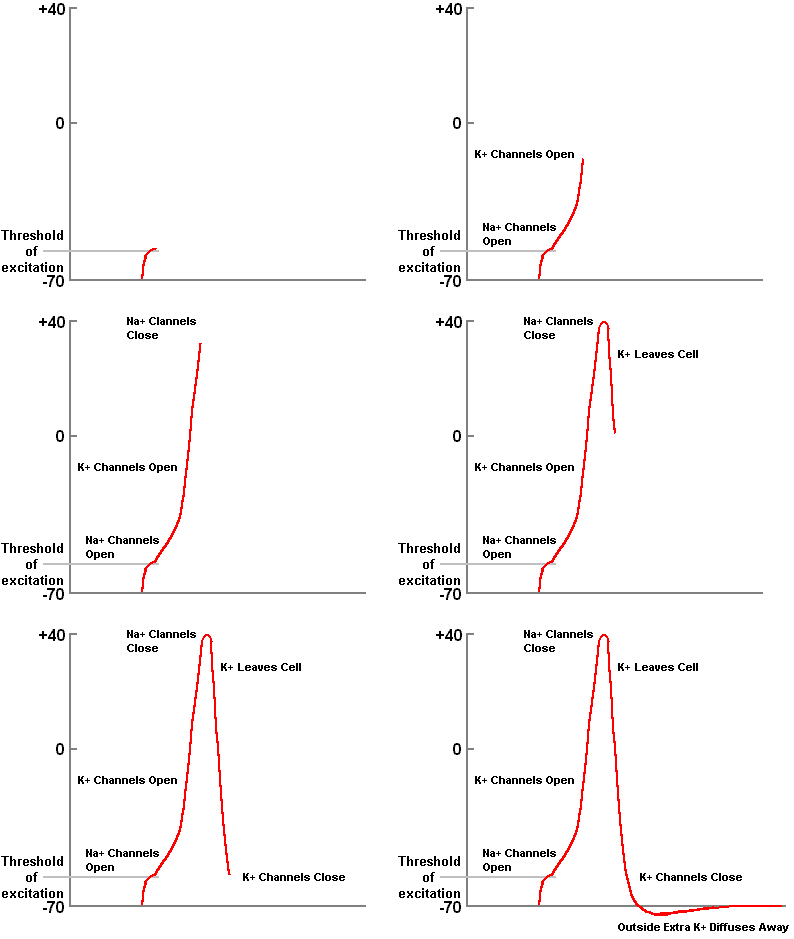
Notice how the action potential involves an influx of Na+ which
causes a region of positive charge that then opens nearby Na+ channels. This "chain
reaction" is how the action potential moves down the axon. Just behind the action
potential, K+ channels open and K+ ions leave the axon taking a positive charge with
them. This brings the axon back to resting potential.
As the traveling signals of nerves and as the localized changes that
contract muscle cells, action potentials are an essential feature of animal life. They
set the pace of thought and action, constrain the sizes of evolving anatomies and enable
centralized control and coordination of organs and tissues.
When a biological cell or patch of membrane undergoes an action potential—or
electrical excitation—the polarity of the transmembrane voltage swings rapidly
from negative to positive and back. Within any one excitable cell, consecutive action
potentials typically are indistinguishable. Also between different cells the amplitudes
of the voltage swings tend to be roughly the same. But the speed and simplicity of
action potentials vary significantly between cells, in particular between different cell
types.
Minimally, an action potential involves a depolarization, a repolarization
and finally a hyperpolarization (or "undershoot"). In specialized muscle cells of the
heart, such as the pacemaker cells, a plateau phase of intermediate voltage may precede
repolarization.
|

 Facebook
 Twitter
 VK
VK